
What Is MB.OS? Inside the Next Generation of Mercedes-Benz Technology
If you’ve shopped for a Mercedes-Benz recently, you’ve probably heard the term MB.OS mentioned alongside the brand’s newest models. It’s the new vehicle operating system Mercedes-Benz engineers built from the ground up to run every core function of the car on one unified platform, handling infotainment and driving assistance alike. We put together this guide to explain how it works and what it changes for drivers. If you’d like to see it in person, you can always contact our team at Mercedes-Benz of Hoffman Estates.
What Is MB.OS? Mercedes-Benz’s New Vehicle Operating System
MB.OS is a purpose-built, chip-to-cloud automobile operating system designed and developed in-house by Mercedes-Benz. Rather than licensing outside software, Mercedes-Benz engineers built this as the standardized central platform across all future models. Building the software internally lets Mercedes-Benz keep control over the customer relationship, protect data privacy, and pull every car function under one roof instead of stitching together systems from multiple suppliers.
A current S-Class runs more than 80 separate electronic control units, or ECUs, each often responsible for a narrow slice of functionality. MB.OS cuts down that complexity by decoupling hardware from software, which lets Mercedes-Benz update and improve vehicle functions much faster than the old model ever allowed. This Mercedes-Benz software approach rebuilds the foundation for how the entire car operates, not just its interface.
MB.OS vs. MBUX: How the New Platform Differs from Current Mercedes-Benz Software
People often use MB.OS and MBUX interchangeably, but they’re not the same thing. MB.OS spans every domain of the car as the vehicle-wide core operating system. MBUX sits on top as the human-facing layer, the voice assistant, menus, and displays drivers actually touch and see. With MB.OS in place, MBUX now runs as its fourth generation, benefiting from far deeper access to vehicle data and cloud connectivity than earlier versions could offer.
Older Mercedes-Benz vehicles running pre-MB.OS infotainment generations have no upgrade path to the new architecture. It requires new hardware and a new electrical architecture, so this isn’t something that arrives via a software patch on an existing car. Those vehicles still receive over-the-air updates, as recent MBUX releases have shown, but those updates work within the older architecture rather than replacing it.
| Category | MB.OS | MBUX (Pre-MB.OS) |
|---|---|---|
| Infotainment Architecture | Vehicle-wide operating system spanning all domains | Interface layer running on separate hardware/software |
| Update Method | OTA updates, including driver-assistance features | Primarily dealer-based updates |
| AI/Voice Assistant | MBUX Virtual Assistant with generative AI, dual Microsoft and Google integration | Voice assistant with more limited AI processing |
| Third-Party Apps | Expanded integration (Antstream, Rovio, Webex, Zoom) | Narrower app support |
| Data Handling | Chip-to-cloud, tied to Mercedes-Benz Intelligent Cloud | Siloed by individual ECU |
| Supported Domains | Infotainment, automated driving, body/comfort, driving/charging | OTA updates focused on infotainment and navigation |
Inside MB.OS: Infotainment, Navigation, and AI Personalization
MB.OS organizes vehicle functions into four central domains: infotainment, automated and autonomous driving, body and comfort, and driving and charging. All four connect back to the Mercedes-Benz Intelligent Cloud, which is what makes the system feel cohesive rather than compartmentalized.
On the infotainment side, the MBUX Virtual Assistant now uses generative AI powered by models including Google’s Gemini and Microsoft-hosted AI, making it the first in-car system to integrate AI from both companies. Navigation runs on the Google Maps Platform with real-time and predictive traffic rerouting, paired with MBUX Surround Navigation, a 3D mapping experience built using a game engine for smoother, more realistic visuals. The MBUX Zero Layer surfaces relevant controls contextually, so drivers see the functions they need without digging through menus. Third-party app integration has also expanded, with arcade gaming through Antstream and Rovio, plus video conferencing via Webex and Zoom, for those charging up or waiting in the car.
Personalization runs deeper than screen preferences. A Mercedes me profile supports up to seven users per vehicle, with a total of roughly 800 parameters shared across those profiles, all stored in the cloud. Those profiles are portable across MB.OS-equipped vehicles, so your seat position can follow you from one car to the next, right along with your climate settings and media preferences.
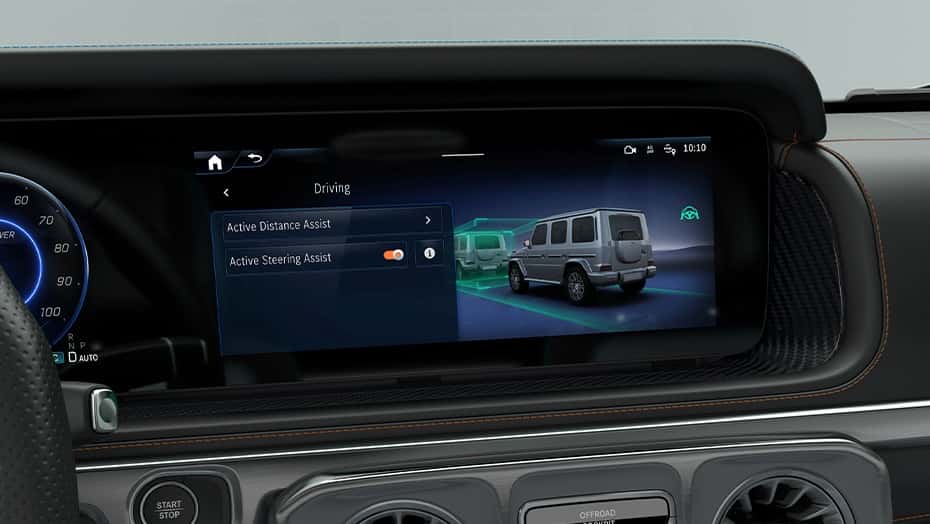
Driver Assistance and Connectivity Capabilities of MB.OS
MB.OS supports driver-assistance systems that start as an enhanced Level 2 experience for urban driving, with the architecture built to move toward Level 3 capability over time. This runs on the NVIDIA Drive platform using the Orin chip. Level 2 means the driver remains fully responsible for monitoring the road at all times, while Level 3 allows hands-off driving under specific, limited conditions in approved markets, not full self-driving.
The updated S-Class introduces MB.DRIVE ASSIST PRO, which handles point-to-point assisted driving in dense urban traffic. It launches first in China, with the US to follow later in 2026 and other markets as regulations allow. On the connectivity front, the Mercedes-Benz Intelligent Cloud works together with Mercedes me ID to link customer data across purchase, financing, service, and charging touchpoints, so the car and the ownership experience stay connected in one system.
Over-the-Air Updates: Keeping MB.OS Continuously Improving
Because MB.OS is built chip-to-cloud, it supports regular OTA updates for key vehicle functions. This includes, for the first time, driver-assistance features on the CLA and GLB, meaning those systems can improve after purchase without a service visit. The S-Class is now considered a software-defined vehicle, or SDV, capable of receiving functional OTA updates rather than requiring hardware changes for every improvement. If you’re weighing a new model against a pre-owned Mercedes-Benz, this update capability is one of the more tangible differences in long-term ownership.
Which Mercedes-Benz Models Feature MB.OS
MB.OS is rolling out gradually across the Mercedes-Benz lineup rather than all at once, starting with newly developed models before reaching the flagship sedan. As of this writing, the rollout includes the CLA, GLB, electric GLC, and the facelifted S-Class, though the lineup is expected to expand as more models are updated.
2025 CLA: The First MB.OS Production Model
The CLA is the first production vehicle to fully run MB.OS, and it reaches US buyers as a 2026 model. It had its world premiere in March 2025, with series production at the Rastatt plant.
GLB and the Expanding MB.OS Rollout
The GLB follows the CLA with a world premiere set for December 8, 2025. It fully runs MB.OS and is built on the MMA, or Mercedes-Benz Modular Architecture, platform it shares with the CLA. Buyers can also opt for the MBUX Superscreen on this model.
Electric GLC and the Updated 2026 S-Class
The electric GLC brings AI-driven MB.OS together with an optional 39.1-inch MBUX Hyperscreen, 800-volt charging, and MB.DRIVE, arriving at US dealerships in the second half of 2026 as a 2027 model. The updated S-Class adds MB.OS to the flagship after the CLA and GLB, unifying systems such as the DIGITAL LIGHT headlamps under one platform. European orders opened January 30, 2026, with the rollout continuing through the year.

What MB.OS Means for Everyday Driving
The real-world benefit of MB.OS comes down to how the four domains work together instead of separately. When infotainment, driving assistance, body and comfort, and charging functions all sit on one platform connected to the Mercedes-Benz Intelligent Cloud, everyday tasks respond faster and feel more personalized than they did under the old approach of 80-plus independent ECUs.
Practically speaking, that means OTA updates can improve your driver-assistance features without a dealership visit, voice commands get processed through generative AI that understands context rather than rigid phrases, and navigation can plan routes with real-time traffic data built right into the system. For electric models, charging and route planning become part of the same connected experience rather than a separate app or afterthought. Personalization now follows the driver, too. Your seat position, media preferences, and climate settings travel with your Mercedes me profile across MB.OS-equipped vehicles, so the car feels familiar even if it’s not the one you drove yesterday.
If you’d like to see these benefits in person, you can explore our new Mercedes-Benz models online.
Experience MB.OS at Mercedes-Benz of Hoffman Estates
MB.OS is a real shift in how Mercedes-Benz vehicles operate, and we think it’s easiest to understand behind the wheel.
Visit Us in the Northwest Chicago Suburbs
If you’re in Hoffman Estates, Schaumburg, or elsewhere in the northwest Chicago suburbs, we invite you to stop by and see how the new CLA drives and feels compared to earlier Mercedes-Benz software generations.
Get in Touch
You can explore our new Mercedes-Benz models online before your visit, or contact our team with questions about availability and upcoming MB.OS-equipped arrivals.
Mercedes-Benz of Hoffman Estates is located at 1000 W. Golf Road, Hoffman Estates, IL 60169. Give us a call at (847) 885-7000 to schedule a test drive or ask about financing and leasing options.
Images by OEM
0 comment(s) so far on What Is MB.OS? Inside the Next Generation of Mercedes-Benz Technology