
Mercedes-Benz Sprinter AWD vs. RWD for Chicagoland Businesses
Hoffman Estates and Schaumburg get real winters, and commercial fleets in the northwest suburbs deal with potholes and unplowed lots as part of the job. If you’re weighing the Mercedes-Benz Sprinter AWD vs. RWD for your business, the decision comes down to your routes, your cargo, and how much winter weather actually affects your bottom line. We’ll walk through how each system works, what it costs, and where it actually pays off on the road so you can make a confident call. Browse our new inventory or contact us if you’d rather talk it through directly.
Sprinter AWD vs. RWD: Which Drivetrain Fits Your Chicagoland Business?
A courier service crossing Chicago on plowed arterial roads has different priorities than an HVAC company climbing gravel driveways in unincorporated Cook County during a lake-effect snow event. Figure out how much weight you’re hauling, how predictable your roads stay through the season, and what downtime actually costs you when the weather turns bad. Answer those honestly, and the drivetrain choice tends to sort itself out.
How the Sprinter AWD and RWD Systems Work
Both systems are engineered by Mercedes-Benz to work with the 9G-TRONIC 9-speed automatic transmission, but they approach traction very differently. Knowing how each one operates helps you understand where the real-world tradeoffs come from, rather than just taking a spec sheet at face value.
On-Demand AWD: Electronic Engagement Explained
The Sprinter’s AWD system, built on 4MATIC® technology, runs primarily as RWD until it detects a loss of traction. At that point, an electric multi-plate clutch automatically routes power to the front axle, splitting torque up to 50% per axle. That’s a meaningful step up from the previous 4×4 system’s fixed 35/65 front-to-rear split. There’s no switch to flip and no driver input required; the system handles engagement on its own, which matters when a driver is focused on navigating a slick loading dock instead of fiddling with controls.
Standard RWD: Simplicity and Predictability
Rear-wheel drive Mercedes-Benz Sprinter vans keep things mechanically simple. Power goes straight to the rear axle, with fewer moving parts to inspect, maintain, or eventually replace. That simplicity shows up in lower maintenance costs and a driving feel that stays consistent trip after trip, which many fleet managers value just as much as raw traction numbers.
Traction and Handling for Winter Routes and Changing Road Conditions
Chicago sees an average of about 38.4 inches of snow each season, with the bulk of it falling between November and March. That’s a real factor for any business running routes through Hoffman Estates, Schaumburg, or the wider Chicagoland area, but it doesn’t automatically mean every van in your fleet needs AWD.
AWD Advantages on Snow, Ice, and Unplowed Job Sites
An AWD Sprinter van shines when the pavement disappears under snow or when job sites haven’t seen a plow yet. Construction crews benefit from the added grip, and so do HVAC technicians heading to rural service calls and mobile service fleets working unpaved lots, especially during the heart of the Chicago snow season.
RWD Performance on Paved and Predictable Routes
On plowed, well-maintained roads, rear-wheel drive Sprinter vans handle just fine. Quality winter tires actually make a bigger difference than AWD for most general winter driving. AWD earns its keep on extreme or backcountry-style routes; for city and suburban routes that stay plowed, a good set of winter tires on an RWD Sprinter often closes most of the traction gap.
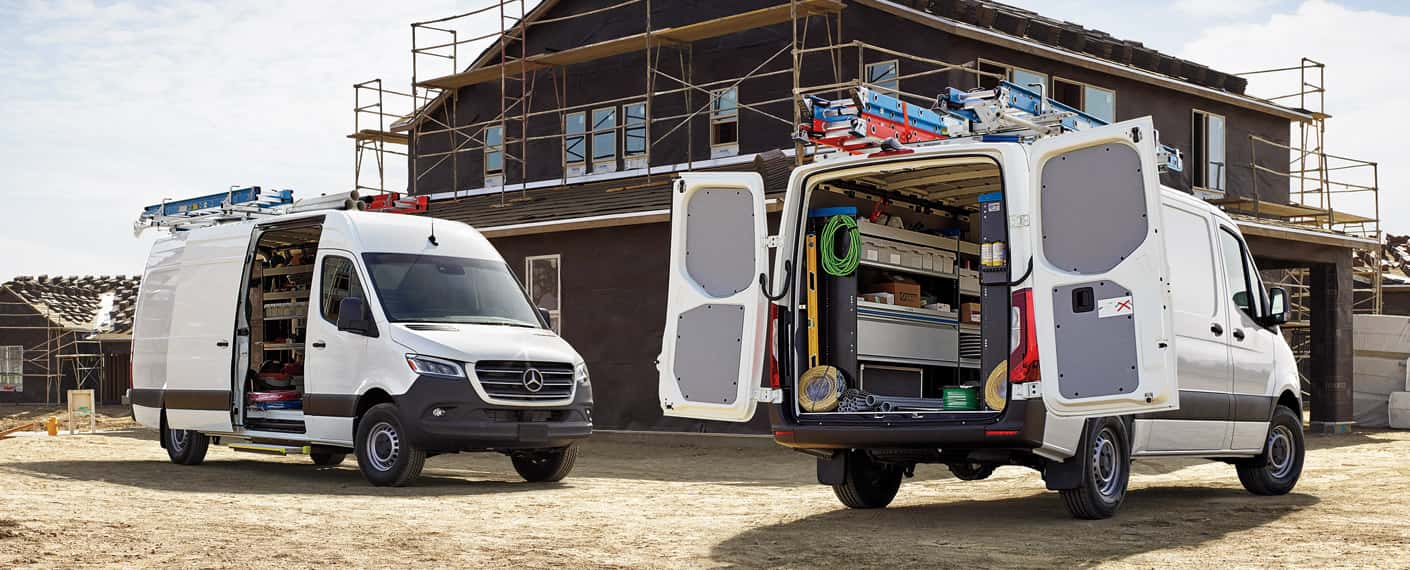
Payload, Upfit Compatibility, and Cargo Considerations
Drivetrain choice has a direct, measurable effect on how much you can haul, and that’s often the deciding factor for businesses running near their weight limits.
How AWD Hardware Impacts Payload Capacity
AWD hardware adds around 200 to 350 lbs of curb weight, and since GVWR stays fixed, that extra weight comes straight out of your payload capacity. On the 2500 High-Output diesel, for example, AWD payload comes in at 3,858 lbs versus 4,211 lbs for the RWD version of the same configuration, a gap that matters if you’re hauling equipment, tools, or product close to the limit every day.
Upfit and Conversion Compatibility by Drivetrain
Both drivetrains accept a wide range of Sprinter upfits, but AWD’s added front-axle hardware can influence how certain conversions are mounted underneath the van. RWD’s simpler underbody generally offers more straightforward clearance for shelving, racking, or refrigeration units, which is worth factoring in if your upfit plans are extensive.
| Drivetrain | Example Payload | Engine Availability | Traction/Terrain Use | Fuel Efficiency (Directional) | Upfront Cost (Directional) |
|---|---|---|---|---|---|
| AWD | ~3,858 lbs (2500 High-Output diesel) | High-Output diesel only | Snow, ice, unplowed job sites | Lower | Higher |
| RWD | ~4,211 lbs (2500 High-Output diesel); up to 6,812 lbs (Cargo Van 4500) | Standard or High-Output diesel | Paved, plowed, predictable routes | Higher | Lower |
Comparing Operating Costs and Long-Term Value
Beyond the sticker price, the total cost of ownership is where a lot of Chicagoland businesses actually make or lose money over a fleet’s lifespan.
Upfront Pricing Differences
The 2026 Sprinter lineup starts at $48,990 MSRP for the Cargo Van WORKER in the 144″ wheelbase, standard roof configuration. Step up to the Cargo Van 2500 in that same body, and Mercedes-Benz lists $50,830 MSRP with the standard output diesel and $53,680 with the high-output diesel. Adding all-wheel drive to the high-output brings it to $60,500, a $6,820 premium over the comparable rear-wheel-drive build and a real number to factor into financing decisions. If you’re mapping out the numbers for your fleet, our financing team can help structure a loan or lease that fits your budget.
Fuel Economy, Maintenance, and Total Cost of Ownership
RWD’s simpler mechanical layout translates to better fuel economy and lower maintenance costs over time, thanks to fewer components that can wear out. AWD costs more to buy and, due to its added complexity, tends to cost a bit more to maintain and fuel over the life of the vehicle. Both drivetrains benefit from Sprinter’s strong resale value and service intervals stretching up to 20,000 miles, which helps offset ownership costs either way.
Maneuverability and Jobsite Access
Tight urban routes and cramped job sites reward a shorter wheelbase more than they reward a particular drivetrain. The 144″ wheelbase remains the most maneuverable Sprinter configuration for city driving, while the 170″ extended wheelbase offers more cargo volume at the cost of a wider turning radius, approximately 52 feet curb-to-curb. AWD doesn’t compromise the tight-turning benefit of a shorter wheelbase, so businesses needing both traction and maneuverability don’t have to choose between them.
Which Businesses Should Choose AWD vs. RWD
Match the drivetrain to your daily operations and the choice usually gets obvious fast.
AWD: Ideal for Suburban, Rural, and Winter-Heavy Routes
If your AWD needs stem from rural service calls, unplowed job sites, or suburban routes exposed to heavy lake-effect snow, that drivetrain earns its higher upfront cost. HVAC companies and mobile service fleets working outside the urban core often see the clearest benefit.
RWD: Ideal for Urban Fleets and Payload-Focused Operations
Delivery and courier operations running plowed city and suburban streets, along with businesses that need every pound of payload for equipment or product, typically do better with RWD. For growing fleets, a mixed approach, some AWD units for winter-heavy or rural routes and some RWD units for payload-focused urban runs, is a legitimate strategy worth considering rather than defaulting to one drivetrain across the board.
Explore Sprinter AWD and RWD Options at Mercedes-Benz of Hoffman Estates
We work with Chicagoland businesses every day to match Sprinter configurations to real routes and real cargo needs, not just spec sheets. Whether you’re comparing a pre-owned 2023 Mercedes-Benz Sprinter cargo van already on our lot or configuring a new 2026 model, our team can walk you through AWD and RWD options, payload tradeoffs, and financing paths that fit your fleet. Give us a call at 847-885-7000 or reach out here to start the conversation.
Frequently Asked Questions
Is AWD available on all Sprinter van configurations?
No. AWD is offered only with the high-output 4-cylinder diesel engine, and the Sprinter 3500 Super Single is rear-wheel drive only.
Does AWD reduce cargo space or payload significantly?
It doesn’t shrink usable cargo volume, but the added hardware weight (roughly 200-350 lbs) does reduce payload capacity compared to an equivalent RWD configuration.
Can snow tires make RWD a viable winter option instead of AWD?
Yes, for most general winter driving on plowed roads. Quality winter tires close much of the traction gap, though AWD still holds an edge on snow, ice, and unplowed terrain.
Images by OEM
0 comment(s) so far on Mercedes-Benz Sprinter AWD vs. RWD for Chicagoland Businesses