
Mercedes-Benz E-Class vs S-Class
- E-Class = attainable luxury & agility; S-Class = flagship comfort, power, and isolation.
- Tech split: E-Class MBUX Superscreen vs. S-Class OLED display, AR-nav, and advanced comfort.
- Ownership: E-Class starts far lower; S-Class commands premium pricing for its top-tier features.
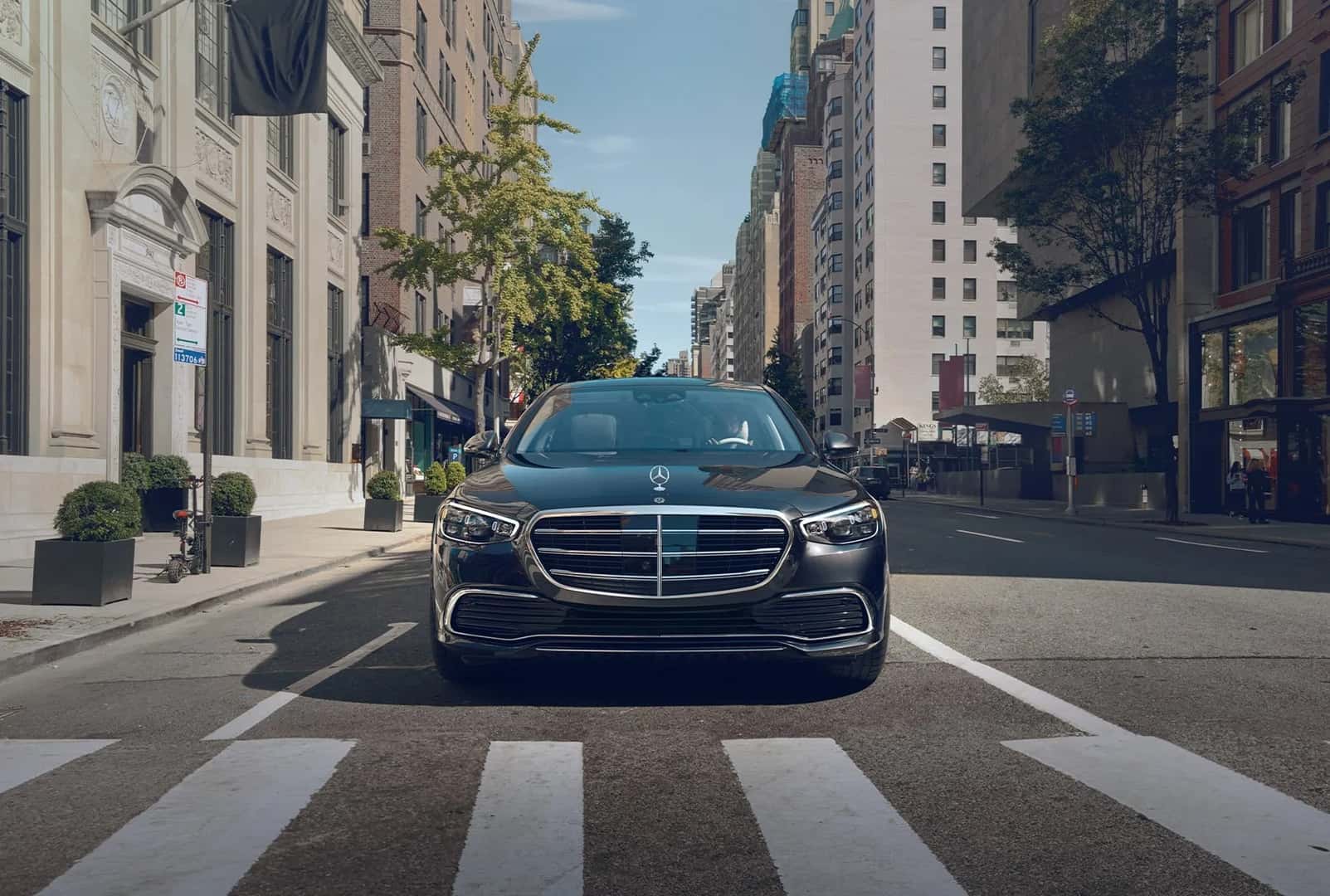
Picking between a Mercedes-Benz E-Class and a Mercedes-Benz S-Class is like choosing between two excellent meals at a five-star restaurant. The E-Class delivers refined luxury that won’t break the bank, while the S-Class is the crown jewel of the Mercedes lineup with all the bells and whistles. For drivers shopping around Chicago, our team at Mercedes-Benz of Hoffman Estates has prepared this E-Class versus S-Class comparison to help you determine which one fits your lifestyle, your taste, and what you expect from a luxury ride.
Performance and Ride Quality
Underneath the hood, the two models are very different. The E-Class has powerful turbocharged engines: a 255-horsepower I-4 in the E 350 Sedan and a 375-horsepower I-6 engine in the E 450 4MATIC® Sedan. The latter’s turbo 3.0-liter engine reaches 375 horsepower with its hybrid setup, accelerating from 0 to 60 mph in 4.4 seconds.
The S-Class packs more punch. The S 500 4MATIC® Sedan delivers 442 horsepower, while the S 580 4MATIC® Sedan’s twin-turbo V-8 engine produces 496 horsepower and 516 lb-ft of torque. The S 580e 4MATIC® Sedan plug-in hybrid combines a gas engine and an electric motor for 503 horsepower plus 47 miles of pure electric driving.
Both classes use a nine-speed automatic transmission with DYNAMIC SELECT drive modes but feel totally different. The E-Class is agile and connected, with multilink suspension plus optional AIRMATIC® suspension. The S-Class is pure floating luxury with standard AIRMATIC® suspension, upgradeable to the E-ACTIVE BODY CONTROL system that reads the road and adjusts instantly. This suspension handles autoleveling, height adjustment, axle lift, and driving modes (Comfort, Sport 1, and Sport 2) with smart damping.
Five drive modes change how these cars behave: ECO saves gas, Comfort gives smooth cruising, Sport tightens response, Sport+ unleashes full power, and Individual lets you customize settings. The E-Class feels sporty when you want it, while the S-Class glides over bumps. Deciding which is your best option will depend on whether you prefer road connection or road isolation.
Interior Comfort and Technology
The technology will inspire gadget lovers. The 2025 E-Class features the Mercedes-Benz User Experience (MBUX) Superscreen — three screens behind a single glass panel: a digital dash, a center touch screen, and an optional passenger screen. The S-Class goes bigger with a massive 12.8-inch OLED screen, a 3D instrument cluster, and augmented reality navigation that overlays directions on real road video. Both have 5G internet, voice commands, touch input, apps such as TikTok and Zoom, plus the MBUX Virtual Assistant for more proactive support.
Materials reflect what you’re paying for. The E-Class has MB-Tex upholstery with leather options, wood or aluminum trim, and 64-color ambient lighting, while the S-Class features standard nappa leather, quilted stitching, illuminated seat belt buckles, and seats that heat, cool, and massage. There’s 64-color lighting plus noise-canceling technology, and all S-Class models feature four-zone climate control.
Size matters for Chicago driving. The S-Class stretches 208.2 inches versus the E-Class’s 194.3 inches. That space translates to 43.8 inches of rear legroom in the S-Class compared to 36 inches in the E-Class. For client transport or tall passengers, the S-Class space advantage could clinch your decision.
Safety and Driver-Assistance Differences
Both these cars feature superior safety systems, but with some key differences. The E-Class won the European New Car Assessment Programme’s “Best Performer” award for 2024, earning a perfect five-star rating and excelling in every crash test. The Insurance Institute for Highway Safety awarded it the top “Good” scores for small-overlap, moderate-overlap, and side-impact crashes. It achieved an “Acceptable” rating for pedestrian crash prevention and a “Good” rating when equipped with the Driver Assistance Package.
The E-Class is fitted with automatic emergency braking and blind-spot warnings. If you want the fancy extras, such as adaptive cruise control that keeps you centered in your lane, that’ll cost more.
With the Driver Assistance Package, you receive:
- Active distance assist (DISTRONIC): keeps you a safe distance from the car ahead
- Active steering assist: helps you stay in your lane
- Evasive steering assist: enables you to avoid obstacles
- Active brake assist with cross-traffic function: watches for cars and people coming from the sides
- Active emergency stop assist: safely stops the car if you’re unresponsive
- PRESAFE® system: preps the car if it thinks a crash is coming
The S-Class ups the ante with the following:
- PRESAFE® PLUS: anticipates and responds to an impending rear-end collision
- PRESAFE® Impulse Side: pushes you bodily away from side impacts
- Route-based speed adaptation: slows the vehicle for curves
- Automatic lane change: switches lanes with just a tap of the turn signal
Ownership Costs and Long-Term Value
Price tags show where these cars fit in Mercedes’ lineup. The 2026 E-Class starts at $63,900 for the E 350 Sedan, climbing to $72,300 for the E 450 4MATIC® Sedan. The S-Class costs almost twice as much, as you’re paying for flagship technology and luxury. The S 500 4MATIC® Sedan starts at $119,500, with the S 580 4MATIC® Sedan and S 580e 4MATIC® Sedan exceeding $130,000.
Fuel costs matter even for luxury buyers. The 2026 E 350 Sedan achieves 25 mpg in the city, 33 mpg on the highway, and 28 mpg combined. The E 450 4MATIC® Sedan delivers 22 mpg in the city, 31 mpg on the highway, and 25 mpg combined. Mercedes provides a four-year/50,000-mile warranty. The current E-Class generation (W213) costs between $700 and $900 yearly in maintenance, with 2017-2023 models the cheapest to run. The Mercedes-Benz Flexible Service System (FSS) alternates between Service A and Service B every 10,000 miles or annually.
The 2009 and 2011 E-Class models prove durable, with many owners reporting 200,000+ miles with care. The S-Class depreciates heavily, losing 60.7% of its value in five years, averaging $71,460 in losses. Certified preowned Mercedes cost 40% less than new models, as new luxury cars drop in value by 20% during the first year. The 2025 E-Class earned a U.S. News 9.1/10 rating and was ranked #1 in its Luxury Midsize Cars category. Car and Driver placed the E 450 4MATIC® Sedan in their 10Best Cars list for its 4.4-second 0-to-60 mph time and 25 mpg combined economy.
Find Your Perfect Mercedes-Benz Match
Choosing the right model for you will depend on your view of luxury. The E-Class is understated — an “executive class” sedan for drivers who want something classy without making a fuss. Car and Driver calls the E 450 4MATIC® Sedan “a return to form,” blending S-Class comfort with C-Class sportiness. The S-Class is aimed at executives and celebrities; hence the price tag.
To find out which fits your Chicago lifestyle, contact our team at Mercedes-Benz of Hoffman Estates and arrange to test-drive both models. Choosing between these cars depends on more than specifications: you need to experience the difference.
Frequently Asked Questions
Which model is better for daily Chicago traffic?
Most commuters will appreciate the E-Class for its smaller footprint and agile feel, while the S-Class focuses on maximum isolation and comfort.
What are the headline performance numbers?
E 450 4MATIC® Sedan hits 0–60 mph in about 4.4 seconds; S 580 4MATIC® produces up to 496 hp and 516 lb-ft for effortless acceleration.
Is there a plug-in hybrid S-Class?
Yes. The S 580e 4MATIC® Sedan pairs a gas engine with an electric motor for 503 hp and up to an estimated 47 miles of electric-only driving.
How do prices compare?
The 2026 E-Class starts around $63,900 (E 350), while the S-Class begins near $119,500 (S 500 4MATIC®) with upper trims well into the $130K+ range.
0 comment(s) so far on Mercedes-Benz E-Class vs S-Class