
Search
-
or select -
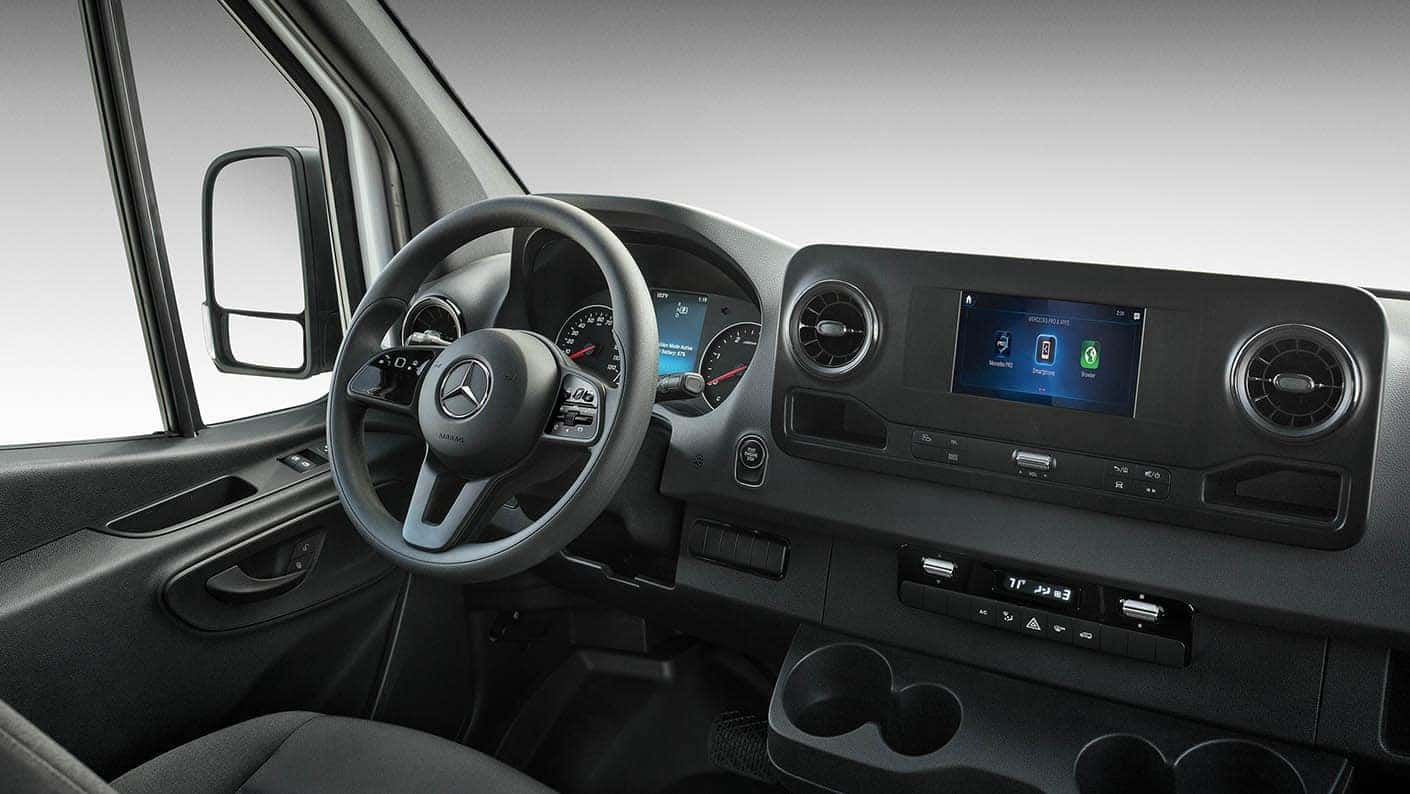
The Mercedes-Benz Sprinter interior is built around the work being done inside it. Cargo Van configurations prioritize open load space and upfit flexibility, Crew Vans combine a second seating row with a usable cargo area, and Passenger Vans are designed to move larger groups with room for up to 15 occupants.
Cab technology has also become a larger part of the Sprinter formula. Available MBUX infotainment, smartphone connectivity, USB-C charging, wireless charging, digital rearview technology, comfort packages, and increasingly configurable seating give businesses more control over how the van functions during a full workday.
Interior space varies dramatically depending on which 2026 Sprinter is being configured. Cargo Vans offer seating for two or three up front and can be ordered with a 144-inch wheelbase, 170-inch wheelbase, or 170-inch extended body, along with standard- and high-roof choices. Passenger Van models provide seating for as many as 15, while Crew Vans add a second row without giving up the majority of the rear load area.
The front cabin can be equipped with the 10.25-inch MBUX touchscreen, navigation, wireless charging, heated seating, and comfort-focused packages. For commercial operators, that turns the driver’s area into more than a place to sit between stops, especially when routes, customer communication, charging, and vehicle information all need to remain accessible throughout the day.
An available 10.25-inch multimedia display supports touch controls, intelligent voice operation, compatible smartphone functions, and available navigation.
Sprinter Cargo Van configurations seat two or three occupants in the front cabin, leaving the rear dedicated to cargo or an upfit.
Passenger Van configurations are designed for group transportation, with a 15-seat arrangement available for shuttle, hospitality, organization, and other passenger-moving uses.
Available comfort packages can add heated front seating, while the Winter Package Plus adds front-compartment heat insulation for colder conditions.
USB-C and 12-volt charging points support mobile devices, with available wireless charging reducing cable clutter in the front cabin.
An available digital interior mirror provides a camera-based rear view that remains usable even when cargo, passengers, or an upfit blocks the conventional sightline.
The 2025 Sprinter retains the current-generation cabin layout, with its interior changing primarily according to body style and equipment rather than through a major redesign. Cargo models maximize open rear volume, Crew Vans add a second seating row, and Passenger Vans trade cargo capacity for dedicated seating and easier movement of larger groups.
Up front, available MBUX gives drivers a 10.25-inch touchscreen with voice control and available navigation. USB-C charging, available wireless charging, smartphone integration, heated-seat options, and practical dash storage make the front compartment better suited to drivers who may spend most of a workday in the van.
The 10.25-inch MBUX system combines entertainment, phone functions, vehicle settings, voice controls, and available navigation.
Cargo Vans provide a large open load floor that can remain clear or be adapted with shelving, bins, partitions, racks, and trade-specific equipment.
High-roof configurations create standing room in the rear compartment, which can make loading, organizing tools, or working inside the van considerably easier.
A second seating row gives businesses room to carry additional workers while preserving a substantial cargo area behind them.
Passenger-focused models offer multi-row seating rather than relying on aftermarket benches added to a cargo shell.
Dashboard storage, USB-C connections, 12-volt outlets, and available wireless charging keep work devices close to the driver.
For businesses that care more about usable dimensions than decorative cabin changes, the 2024 Sprinter offers one of the broadest interior footprints in the lineup. Cargo Van configurations can provide as much as 533 cubic feet of cargo volume, up to 189 inches of cargo-floor length, and as much as 79 inches of standing height.
The cargo compartment is intentionally uncomplicated so it can be adapted around different trades. Pallet bracing, tie-down provisions, available LED cargo lighting, squared wheel-arch coverings on certain single-rear-wheel models, and multiple roof and body combinations give contractors and fleet operators several ways to build around the equipment they actually carry.
The largest Cargo Van configuration provides up to 533 cubic feet of rear cargo volume.
Extended-body models provide enough floor length for bulky equipment, shelving runs, long materials, or large delivery loads.
High-roof models allow many adults to stand upright in the rear compartment rather than crouching while loading or working inside.
Available cargo-area lighting improves visibility when loading tools, packages, or equipment before sunrise or after dark.
Load-management features help secure irregular cargo and support commercial loading requirements.
The front cabin can be equipped with Mercedes-Benz’s larger touchscreen multimedia system, smartphone integration, voice control, and available navigation.
The largest differences inside a 2024 Sprinter come from wheelbase, roof height, body length, seating configuration, and upfit rather than from trim-level styling changes.
The 2023 Sprinter continued to give businesses several fundamentally different interior layouts rather than forcing every van into the same format. Cargo Vans devote most of the body to open load space, Crew Vans add a second row for additional workers, and Passenger Vans use multi-row seating for group transportation.
Inside the cab, buyers could choose between the standard audio setup and available MBUX equipment with touchscreen controls and navigation. Heated seating, wireless charging, automatic climate control, additional storage, and upgraded convenience equipment were also available depending on configuration.
The largest Cargo Van configuration provides more than 530 cubic feet of usable rear volume for commercial loads and upfits.
The extended configuration provides nearly 16 feet of usable cargo-floor length for long materials, equipment, shelving, or delivery loads.
High-roof models create enough vertical clearance for many adults to stand upright while working or organizing cargo.
The space between the rear wheelhouses helps determine how pallets, storage systems, and trade-specific equipment can be positioned.
Available touchscreen infotainment adds intelligent voice control, compatible smartphone functions, and available navigation to the driver’s workspace.
Available LED strip lighting improves visibility throughout the rear compartment when loading or finding equipment in low-light conditions.
Body length, roof height, seating layout, and commercial equipment have a much greater effect on Sprinter usability than decorative trim differences.
The 2022 Sprinter already offered many of the cab features still associated with newer models, including available MBUX touchscreen infotainment, navigation, wireless device charging, automatic climate control, and heated seating. That makes well-equipped 2022 vans considerably more modern inside than a basic commercial cabin might suggest.
The rear compartment remained highly dependent on body style. Cargo models supplied an open shell for storage systems and professional upfits, while Passenger Vans added dedicated multi-row seating and passenger-focused equipment. The broad factory options list also allowed businesses to order heating, storage, electrical, and convenience equipment around the job the van needed to perform.
The 2022 Sprinter could be equipped with MBUX multimedia, including touchscreen operation and compatible voice-control functions.
Factory navigation could be integrated with the available MBUX system for drivers covering unfamiliar routes or multiple job sites.
A smartphone tray with wireless charging helped keep compatible devices powered without adding another cable to the dashboard.
Automatic climate control was available for more consistent front-cabin temperature management during long workdays.
Available heated driver and front-passenger seats added useful cold-weather comfort for Chicagoland routes and early-morning starts.
Overhead and dashboard storage areas give drivers places for paperwork, small tools, devices, and other items needed between stops.
The basic Sprinter interior architecture remained consistent across these model years, with the biggest differences coming from equipment availability and configuration rather than repeated dashboard redesigns. MBUX, smartphone integration, charging, driver-comfort options, digital visibility features, and commercial packages became increasingly important as more operators began using the front cabin as a mobile workspace.
The rear compartment follows the same practical approach. A high-roof extended Cargo Van is fundamentally different inside from a 144-inch Crew Van or a Passenger Van, even when all three share the Sprinter name. Wheelbase, roof height, body length, seating, and upfit choices determine how much room is available and how that space can actually be used.
| Model Year | Cab Technology | Interior Configuration | Notable Interior Characteristics |
|---|---|---|---|
| 2026 | Available 10.25-inch MBUX, smartphone integration, wireless charging | Cargo, Crew, Passenger, Passenger Select, Cab Chassis | Current cab technology with broad seating, comfort, and commercial equipment choices |
| 2025 | Available 10.25-inch MBUX and connected features | Cargo, Crew, Passenger, Cab Chassis | Modern cab with extensive body, roof, and upfit flexibility |
| 2024 | Available MBUX touchscreen and navigation | Cargo, Crew, Passenger, Cab Chassis | Up to 533 cu. ft. of cargo space with multiple roof and body combinations |
| 2023 | Available touchscreen MBUX and navigation | Cargo, Crew, Passenger, Cab Chassis | Up to 532.6 cu. ft. of cargo volume and 79.1 inches of standing height |
| 2022 | Available MBUX, navigation, wireless charging | Cargo, Crew, Passenger, Cab Chassis | Strong mix of commercial storage, comfort, and connectivity options |
The largest Sprinter Cargo Van configurations provide roughly 533 cubic feet of cargo volume, nearly 16 feet of cargo-floor length, and about 79 inches of interior standing height. The width between the wheelhouses is approximately 53 inches, while the maximum interior floor width is considerably greater above and around the wheel arches.
Those dimensions support very different commercial layouts. An electrician may prioritize full-length shelving and small-parts bins, while a delivery operation may leave more of the floor open for packages and rolling carts. Contractors carrying ladders, pipe, lumber, or large equipment may benefit more from extended length and high-roof clearance than from maximum passenger capacity.
A standard-roof Sprinter keeps overall vehicle height lower, which can be useful for businesses that regularly enter parking structures, loading areas, or other locations with limited overhead clearance.
High-roof configurations provide substantially more vertical room inside, allowing many users to stand while loading, sorting cargo, or accessing shelving mounted above waist height.
The 144-inch wheelbase is easier to maneuver and requires less space to park, making it practical for service businesses spending much of the day moving between dense job sites. The longer 170-inch wheelbase creates additional usable floor area for shelving, large tools, equipment, passenger seating, or higher-volume deliveries.
An extended-body version of the 170-inch Sprinter increases rear cargo length even further. Businesses rarely need the largest van simply because it exists, so the useful choice depends on the amount of equipment carried every day, how often the van operates near capacity, and where it needs to maneuver.
The Cargo Van devotes the rear compartment primarily to goods, tools, materials, or a professional upfit. Front seating generally accommodates two or three occupants depending on configuration.
The Crew Van adds a second row behind the front seats so additional workers can travel together while leaving a substantial load area behind them.
Passenger Vans replace much of the open cargo area with factory seating for group transportation, with configurations accommodating as many as 15 occupants.
Cab Chassis models provide the front cabin and chassis structure for specialized bodies such as service boxes, utility bodies, delivery bodies, and other commercial conversions.
A commercial van operating around Hoffman Estates may spend the same day on I-90, at suburban job sites, inside industrial parks, and making deliveries in tighter commercial areas. Cab storage, accessible charging, navigation, available digital rear visibility, and a seating position designed for long hours all become more important when the van functions as both transportation and workspace.
Interior dimensions matter just as much once the van reaches the job. High-roof clearance can make it easier to work inside during a cold Illinois morning, while longer wheelbase configurations provide space for permanent shelving without consuming the entire center aisle. Smaller configurations can make more sense for businesses that value easier parking and frequent stops over maximum cubic volume.
The open rear structure of the Sprinter Cargo Van supports shelving, drawers, partitions, ladder storage, workbenches, refrigeration equipment, delivery systems, and other specialized installations. Mercedes-Benz also provides technical dimensional information for upfitters, which helps commercial equipment installers plan around the van’s body structure and available mounting areas.
Planning the interior around daily workflow usually produces a more useful van than simply filling every wall with storage. Frequently used tools should remain accessible from the side or rear doors, heavier equipment needs secure placement, and enough floor space should remain open for the cargo that changes from one job to the next.
Mercedes-Benz of Hoffman Estates offers Sprinter configurations for contractors, delivery operations, passenger transportation, service businesses, and other commercial uses throughout the Chicago area.